
Best Earrings for an Oval Face: 10 Styles Chosen by Proportion
Oval faces can wear a wide range of earrings, but that does not mean every shape creates the same effect.
The part I would look at first is proportion .
If your oval face leans long, earrings with more width near the cheek or ear can create better balance. If your face is a rounder oval, you have more freedom to use longer, narrower shapes.
That is why I would not recommend “hoops,” “studs,” or “drops” as broad categories. A medium round hoop and a tall oval hoop behave differently. So do a tiny solitaire stud and a wide floral cluster. If those category names are still too broad, I would first compare the main types of earrings and then come back to proportion.
The useful question is:
What direction, width, and visual weight does the earring add beside your face?
Best Earrings for an Oval Face at a Glance
| Earring style | What it does visually | I would choose it for |
|---|---|---|
| Medium round hoops | Adds width beside the cheeks | Most oval faces, especially longer ovals |
| Rounded or floral cluster studs | Adds width without extra length | Longer oval faces |
| Small stone-set huggies | Keeps detail high and close to the face | Minimal everyday looks |
| Medium teardrops | Combines width and length | Most oval proportions |
| Short sphere drops | Adds movement with a clear stopping point | Longer oval faces |
| Pearl cluster studs | Adds soft width and texture | Longer or delicate oval faces |
| Cube or square studs | Adds angular contrast | Soft-featured oval faces |
| Radial statement studs | Creates scale near the cheekbones | Longer oval faces |
| Tiered chandeliers | Adds movement without one long vertical line | Events and hair-up looks |
| Upward ear climbers | Moves attention upward | Longer oval faces |
I would use this as a shortlist, not a set of rules.
The same oval face may suit several of these styles for completely different reasons.
First, Decide What Kind of Oval Face You Have
“Oval” is useful, but it is still a broad description.
Two people can both have oval faces and need different earring proportions.
A Typical Oval Face
An oval face usually has:
- More length than width
- Slightly wider cheekbones
- A softly curved jaw
- A chin that narrows gently
- No very strong corners
You do not need exact measurements.
I would look at the overall silhouette in a straight-on photo or mirror.
If Your Oval Face Leans Long
This is the variation where width becomes more useful.
I would start with earrings that create visible shape beside the cheek or ear, such as:
- Medium round hoops
- Cluster studs
- Pearl clusters
- Radial statement studs
- Fuller teardrops
- Wider chandeliers
- Ear climbers
Long earrings are still possible.
I would simply be more selective with designs that are one uninterrupted thin vertical line.
If Your Oval Face Is Rounder
A rounder oval already has a little more width.
That gives you more room for:
- Narrow teardrops
- Longer drops
- Tall oval hoops
- Slim chandeliers
- Linear earrings
These can add vertical direction without making the face feel overly long.
Oval vs. Round vs. Oblong
A round face usually has less difference between length and width and often looks fuller through the cheeks.
An oblong face usually has noticeably more vertical length, with less taper from forehead to jaw.
An oval sits between those two.
If you are not sure which label fits perfectly, I would not worry too much. Use the recommendation that matches the proportion you actually see.
The goal here is to be specific enough that you can recognize the useful silhouette when shopping.
Oval Face Proportion Guide
Before choosing a style, decide whether your oval face reads longer, rounder, or close to balanced.
| Face proportion | Good starting point | Watch for |
|---|---|---|
| Longer oval | Round hoops, clusters, fuller teardrops | Very thin vertical designs |
| Balanced oval | Most medium-scale shapes | Overthinking the label |
| Rounder oval | Narrower drops, oval hoops, slim chandeliers | Adding more width than you want |
| Delicate features | Open or medium-weight shapes | Very thick oversized earrings |
| Stronger features | Larger studs, hoops, broader drops | Tiny details disappearing |
1. Medium Round Hoops

If I had to recommend one shape before knowing anything else about your style, I would start with a medium round hoop. Comparing a few hoop earring sizes on the ear is more useful than judging diameter from a product photo alone.
The important part is the combination of those two words.
Medium gives you enough presence to affect the face without turning the earring into a large statement.
Round gives you horizontal width.
That is especially useful on an oval face that leans long.
A very small huggie stays close to the lobe and does little to change facial proportion. The difference between hoops and huggies is useful here because they place visual weight in different places.
A very large hoop can dominate the look.
A medium round hoop sits in the middle.
Round Hoops vs. Tall Oval Hoops
If your face already looks long, I would usually choose the rounder shape.
A tall oval hoop repeats the vertical direction of the face.
A circle adds more width.
If your face is a rounder oval, the taller hoop can work well when you want a slightly more elongated look.
Grace Studio Example: Minimalist Silver Round Hoops
The Minimalist Silver Round Hoops are a straightforward example of the silhouette I mean.
I would use this kind of clean circular shape as the first comparison point for a longer oval face.
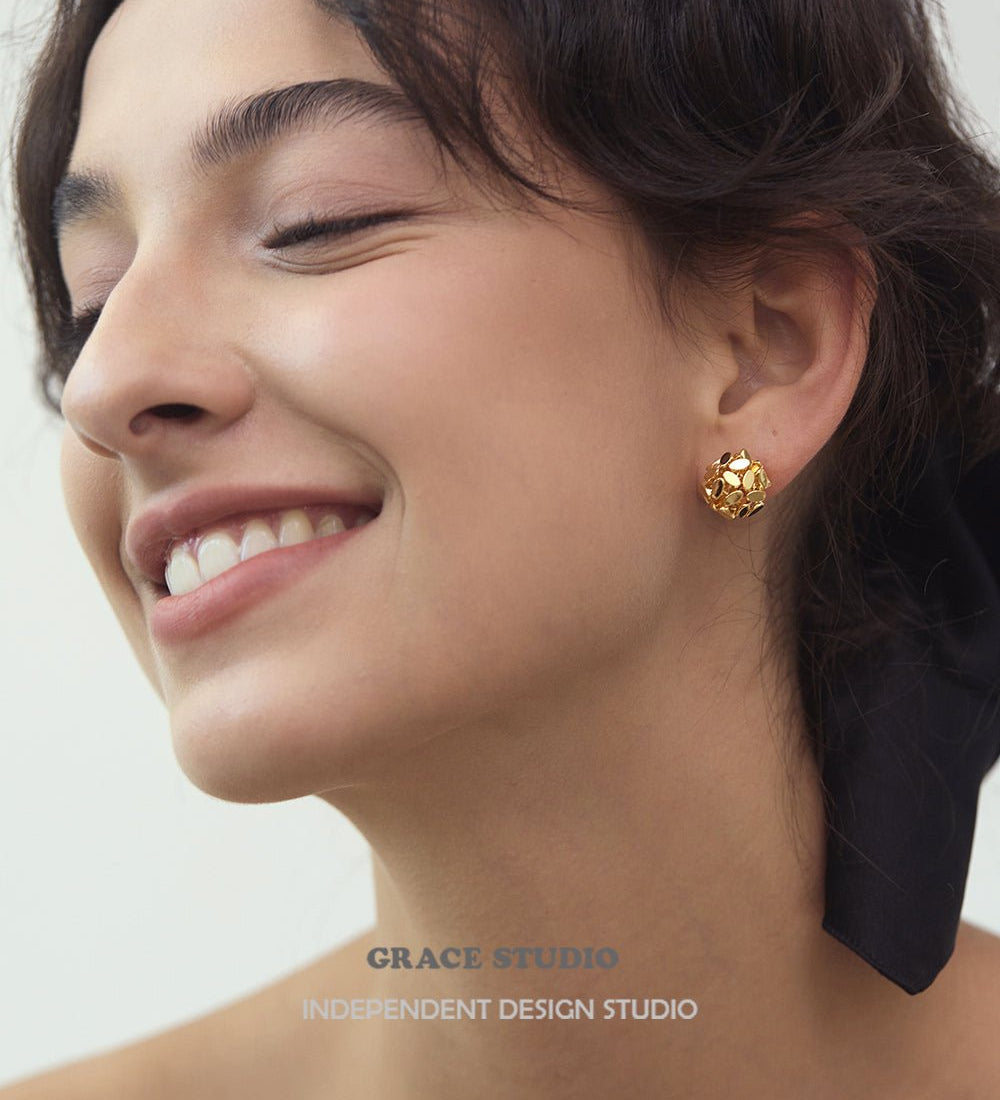
2. Rounded or Floral Cluster Studs

Stud earrings are too broad to be useful here as one single recommendation.
A tiny solitaire and a wide floral cluster are both studs, but they create completely different proportions.
For a longer oval face, I would look for a stud that spreads across the lobe.
Good shapes include:
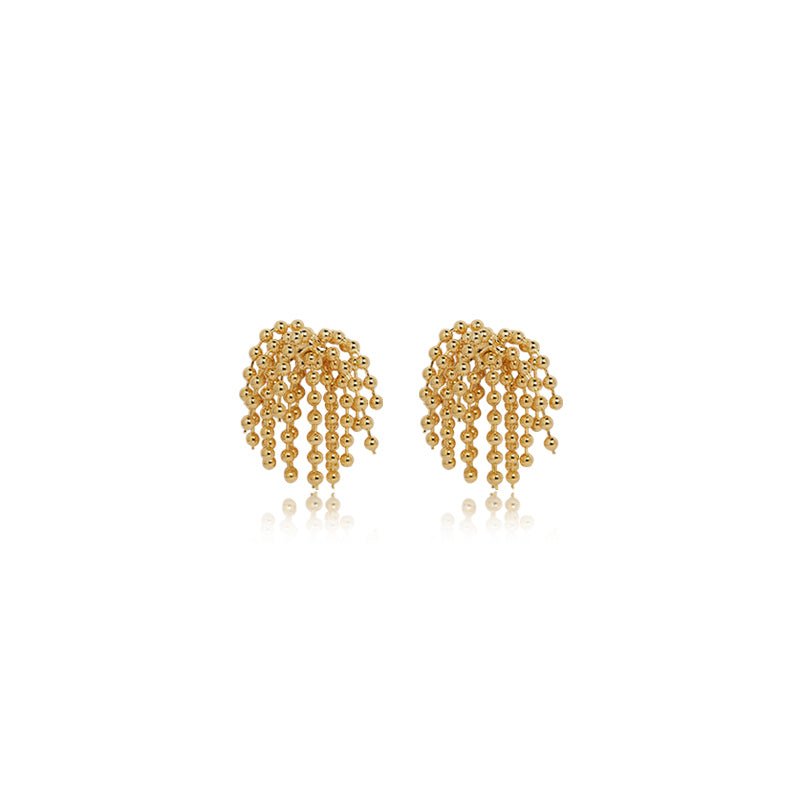
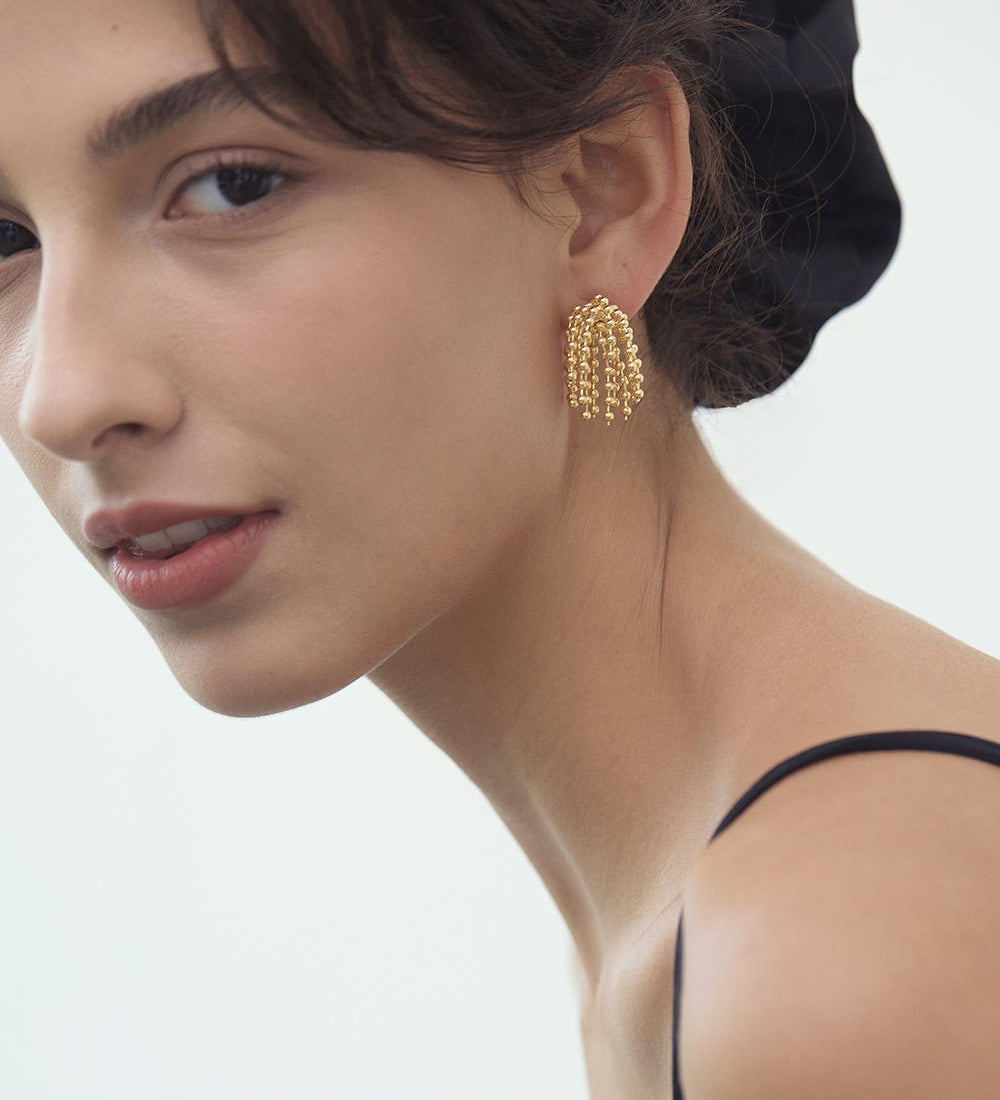
- Floral clusters
- Rounded bead clusters
- Multi-stone clusters
- Soft starbursts
- Compact petal forms
The advantage is simple.
You get more width and presence near the cheekbone without adding another vertical line below the ear.
This is especially useful if tiny studs tend to disappear on you.
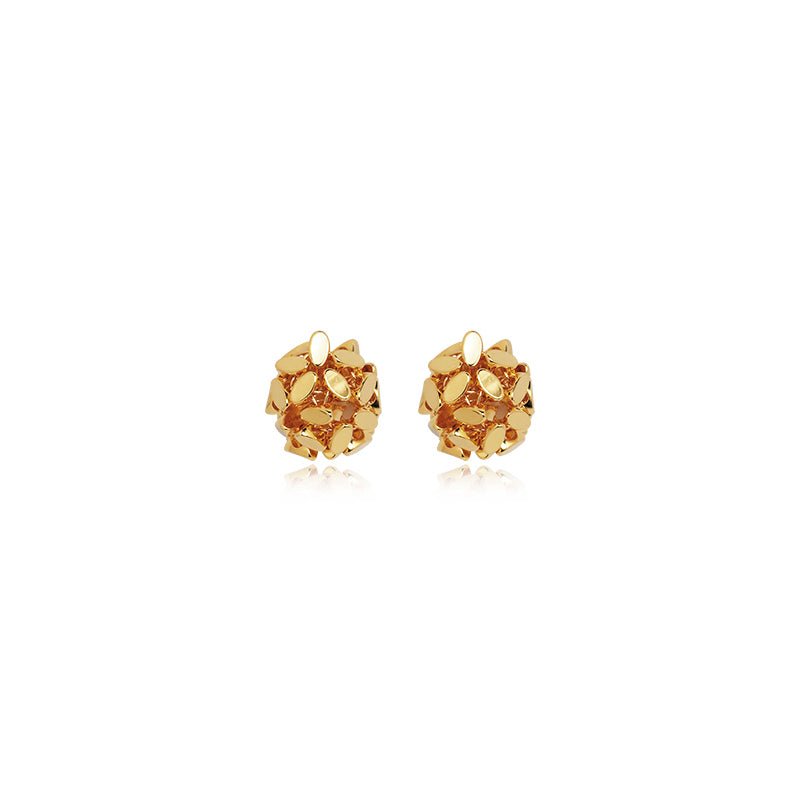
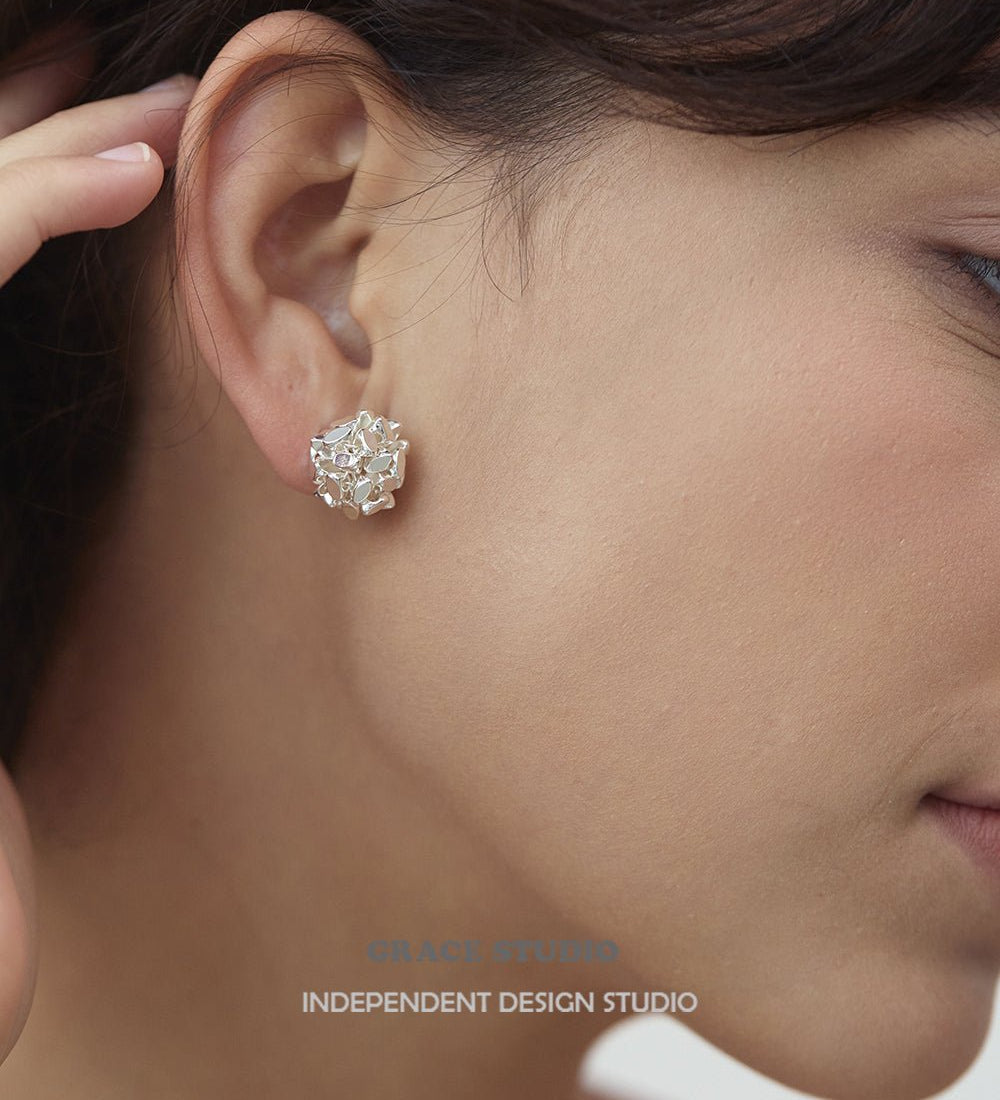
Grace Studio Example: Floral Blossom Cluster Studs
The Floral Blossom Cluster Studs fit this recommendation because several petal-like elements gather into one compact flower.
The important part is the footprint.
It creates more width than a conventional solitaire while staying close to the ear.
3. Small Stone-Set Huggies

Huggies can be thin, chunky, elongated, sculptural, plain, or stone-set.
So I would narrow the recommendation.
For an oval face, I particularly like:
small huggies with a close fit and enough surface detail to remain visible.
They keep visual interest high on the face and avoid adding much downward length. That compact scale also works naturally with minimalist jewelry if you prefer a quieter everyday look.
That makes them useful for:
- Everyday wear
- Work
- Hair worn down
- Multiple piercings
- Minimal outfits
Why I Like a Little Stone Detail Here
A completely plain tiny huggie can disappear.
A small line of stones adds enough light to make the earring visible while keeping the silhouette compact.
That is useful if your oval face is already long and you do not want more vertical emphasis.
Grace Studio Example: Crystal Channel Set Huggie Hoops
The Crystal Channel Set Huggie Hoops are about 1 cm and use a compact stone-set huggie shape.
That is much closer to the recommendation I would make than simply saying “huggies suit oval faces.”
What Different Earring Proportions Do
Two earrings in the same category can create very different effects depending on where the width sits.
| Earring proportion | Visual effect | Good for |
|---|---|---|
| Round + medium | Adds width beside the cheeks | Longer ovals |
| Tall + narrow | Adds vertical direction | Rounder ovals |
| Short + broad | Keeps attention high | Longer ovals |
| Fuller lower shape | Balances length with width | Most oval faces |
| Upward shape | Moves attention toward the ear | Longer ovals |
4. Medium Teardrop Earrings

Teardrops are useful because they combine two directions at once.
They add length.
They also add width.
That makes them easier to balance than a narrow bar, chain, or threader.
A typical teardrop:
- Starts narrower near the ear
- Widens lower down
- Has a curved outline
- Creates movement without staying completely linear
Choose the Width Based on Your Face
If your oval face is long, I would choose a fuller teardrop.
If your face is a rounder oval, a narrower teardrop can add more vertical direction.
The category stays the same.
The proportion changes the effect.
Grace Studio Example: Coral Blossom Silver Teardrop Earrings
The Coral Blossom Silver Teardrop Earrings are about 2.5 cm long and use a visible teardrop with real width.
That lower width is the reason I like the shape for a longer oval face.
5. Short Sphere Drops

If you like movement but do not want a long earring, I would look for a short drop with a rounded or substantial form near the bottom.
A 7 cm chain drop and a 2.5 cm sphere drop are both “drop earrings.” The distinction between drop and dangle earrings is useful here because movement and construction change how strongly the design reads as a vertical line.
They do not behave the same way.
The sphere gives the eye a stopping point.
Instead of following one fine line downward, your attention lands on the wider lower shape.
That makes this style especially useful for longer oval faces.
Other versions of the same idea include:
- Short pearl drops
- Rounded gemstone drops
- Pebble drops
- Disc drops
- Compact sculptural drops
The common feature is visual weight near the bottom .
Grace Studio Example: Minimalist Cinnabar Sphere Drop Earrings
The Minimalist Cinnabar Sphere Drop Earrings measure about 2.5 cm overall, with a sphere around 1.5 cm wide.
That proportion is exactly why they work here.
The rounded form is a major part of the silhouette rather than a tiny detail at the end of a long chain.
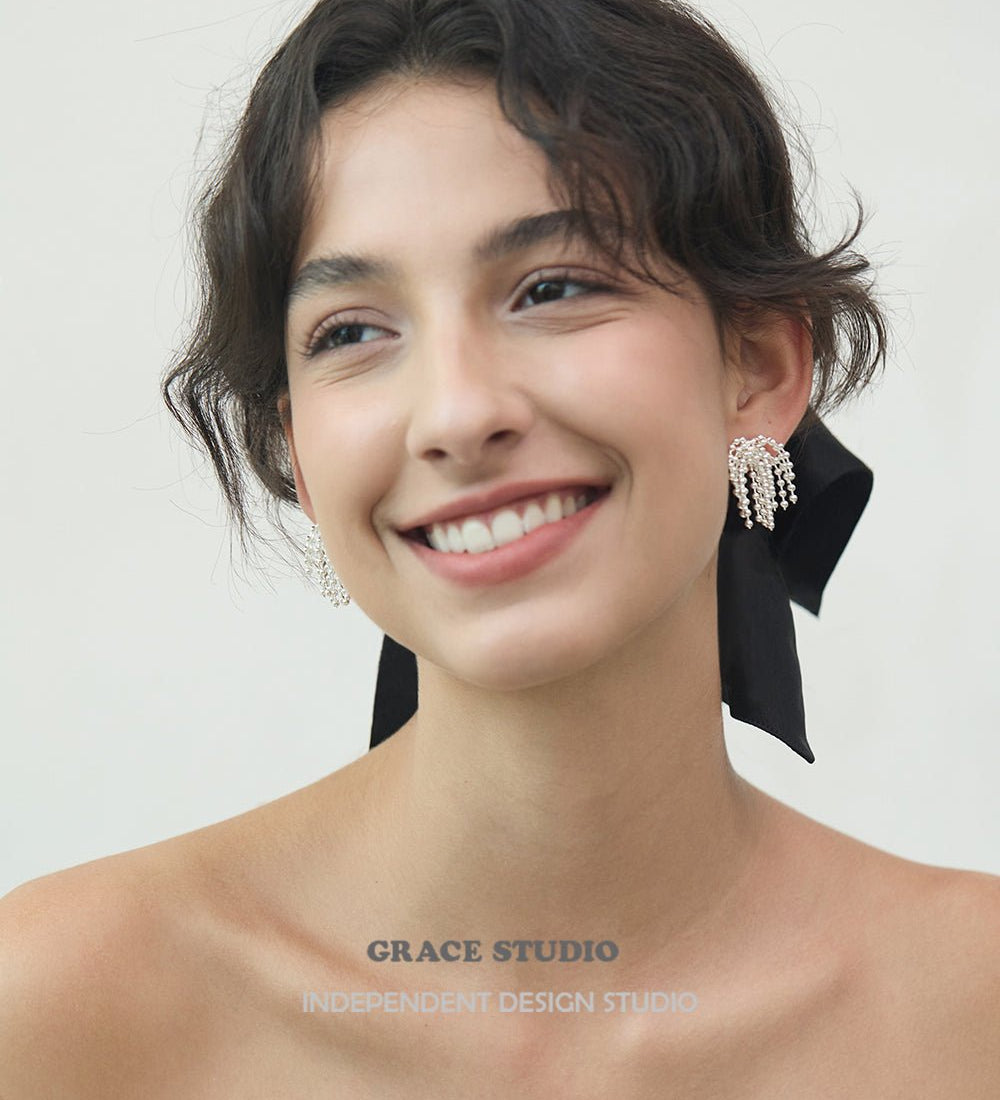
6. Pearl Cluster Studs

A single pearl stud works perfectly well on an oval face. It is also one of the easiest shapes to fold into a classic jewelry rotation.
But if I am trying to recommend the most useful pearl silhouette for a longer oval, I would choose a cluster.
Several pearls grouped together create:
- More width
- More visibility
- More texture
- No extra downward length
You still get the softness associated with pearls, but the shape has more presence near the ear.
If your face is already a rounder oval and you want something very subtle, a single pearl may make more sense.
Grace Studio Example: Petite Pearl Cluster Stud Earrings
The Petite Pearl Cluster Stud Earrings are a cleaner match for this recommendation than a long pearl design.
The cluster keeps the pearls close to the lobe and builds width instead of length.
7. Cube or Square Geometric Studs

“Geometric earrings” can mean almost anything.
A tiny square and a shoulder-length rectangle are both geometric.
For a soft-featured oval face, I would start with small angular geometry close to the ear. That is also an easy way to introduce a more sculptural jewelry direction without adding much length.
Good options include:
- Cubes
- Squares
- Compact rectangles
- Small hexagons
- Angular domes
Oval faces usually have more curves than strong corners.
A square or cube introduces contrast without adding much length.
That is a more precise reason to choose the style.
Grace Studio Example: Faceted Cube Crystal Stud Earrings
The Faceted Cube Crystal Stud Earrings use a three-dimensional geometric form measuring about 0.8 cm.
The small scale keeps the earring close to the ear while the cube adds the angular contrast.
8. Radial Statement Studs

Statement earrings do not have to hang below the jaw. A radial or oversized stud can create a stronger fashion jewelry effect through width rather than length.
For a longer oval face, I often prefer a statement earring that expands outward rather than downward.
That could be:
- Starbursts
- Sunbursts
- Wide florals
- Fan studs
- Broad clusters
A radial shape sends the eye outward and diagonally around the ear.
You get scale without adding several more centimeters of vertical length.
That makes it one of the strongest statement options for a longer oval.
Grace Studio Example: Radiant Spike Burst Cluster Stud Earrings
The Radiant Spike Burst Cluster Stud Earrings use spikes radiating around a central point.
That radial construction is exactly what I would look for here.
The earring feels bold because of width and direction, not because it hangs far down the face.
9. Tiered Cascade Chandeliers

Chandeliers can work beautifully on oval faces, but “chandelier” is still a very broad category.
For a longer oval face, I would look for:
tiers + visible width + controlled overall length
The tiers matter because they interrupt one long vertical line.
Instead of the eye moving straight down, it moves through several sections.
For longer oval faces, I would prioritize:
- Wider tiers
- Multiple strands
- Short-to-medium overall length
- Fuller lower sections
For a rounder oval, a narrower or slightly longer chandelier can work if you want more vertical direction.
Grace Studio Example: Beaded Cascade Dangle Earrings
The Beaded Cascade Dangle Earrings use multiple beaded strands in graduated lengths.
That creates the kind of tiered chandelier silhouette I would choose over one very long narrow strand.
10. Upward Ear Climbers

Most earrings move below the lobe.
Ear climbers move in the opposite direction.
That is exactly why they can be useful for a longer oval face.
A short upward-following climber can add:
- Sparkle
- Shape
- Detail
- Visual movement
without extending farther down the side of the face.
They are especially noticeable with hairstyles that expose the ear. The same visibility principle matters when choosing earrings for short hair:
- Ponytails
- Buns
- Half-up hair
- Hair tucked behind the ear
Grace Studio Example: Dazzling Cascading Moissanite Stud Earrings
The Dazzling Cascading Moissanite Stud Earrings use a graduated arc that follows upward along the ear.
That upward direction is the reason I would choose them for this section rather than treating them as just another stud.
Hair and Earring Visibility Guide
Hair can change how much of the earring is visible and where the visual weight sits.
| Hair situation | Good starting point | Watch for |
|---|---|---|
| Hair down | Hoops, clusters, broader drops | Tiny earrings disappearing |
| Hair tucked back | Studs, climbers, compact drops | Over-scaling because the ear is exposed |
| Ponytail / bun | Chandeliers, radial studs, climbers | Too much visual weight |
| Short hair | Medium hoops, sculptural studs | Going oversized just for visibility |
| Hair at cheek level | Clear silhouettes | Earrings merging into the hair |
How to Choose Between These 10 Styles
A list of ten shapes is only useful if you know how to narrow it.
I would use four questions.
Do You Want More Width or More Length?
If your face leans long, I would start with:
- Round hoops
- Cluster studs
- Pearl clusters
- Radial studs
- Fuller teardrops
If your oval is rounder and you want more vertical movement, I would compare:
- Narrower teardrops
- Longer drops
- Oval hoops
- Slim chandeliers
This is the main proportion decision.
Where Does the Earring Become Widest?
This matters more than people expect.
A teardrop that widens near the jaw creates a different effect from a thin line that stays narrow all the way down.
A chandelier with broad tiers behaves differently from one made from three long chains.
I would always look at the widest point of the design.
Where Does the Earring End?
The stopping point changes the overall silhouette.
An earring that ends close to the lobe keeps attention high.
One that ends around the jaw creates a stronger relationship with the lower face.
A shoulder-grazing earring adds much more vertical direction.
If your face already leans long, I would pay close attention to that final point.
Is the Earring Adding Shape or Simply Adding Size?
This is how I think about statement earrings.
A large earring is not automatically useful.
I want the size to create a specific direction.
A radial stud adds width.
A tiered chandelier adds controlled movement.
A broad teardrop adds both width and length.
A very long narrow bar mostly adds length.
That distinction makes shopping much easier.
Hair, Scale, and Personal Style Can Change the Answer
Face shape is only one part of the picture. Neckline can change the amount of open space around the face too, so I would also consider what earrings match each neckline.
Hair Down
Hair can hide smaller earrings.
If your hair sits around the cheeks, it may already add some width beside the face.
That can make a narrower drop easier to wear than it would be with the hair fully pulled back.
Hair Up
With a bun or ponytail, the full earring shape becomes much more visible.
This is where I would pay closer attention to:
- Hoop width
- Cluster size
- Chandelier length
- Radial statement shapes
- Ear climbers
Small Features vs. Stronger Features
Two oval faces can have very different scales.
If your features are delicate, a very thick oversized hoop may feel stronger than you want.
If your features are more substantial, a tiny stud may disappear.
I would scale the earring to the whole face rather than the face-shape label alone.
Comfort Still Matters
A flattering silhouette does not help if the earring is too heavy or irritating to wear. If irritation is a recurring issue, I would separately check materials that tend to work better for sensitive ears.
For longer or larger styles, I would still check:
- Weight
- Closure
- Movement
- Hair contact
- Whether the earring touches the shoulder or collar
The best face-shape recommendation still has to work in real life.
My Quick Shopping Test
When I compare earrings for an oval face, I ask:
- Does my face lean long or rounder?
- Is the earring adding width, length, or both?
- Where is the widest part of the design?
- Where does the earring end?
- Is the shape rounded or angular?
- Does my hair hide part of the earring?
- Is the earring large because of shape or because of physical weight?
- Do I actually like the effect?
That last question matters most.
Oval faces already have relatively balanced proportions. You do not need to “fix” anything.
The goal is simply to understand what the earring is doing so you can choose the effect you want.
Quick Style Selector for Oval Faces
Use the effect you want rather than choosing by earring category alone.
| Your goal | Good starting point | Watch for |
|---|---|---|
| Add width | Round hoops, clusters, radial studs | Tall narrow shapes |
| Add length | Narrow teardrops, oval hoops | Overdoing length on a long oval |
| Keep it minimal | Huggies, compact studs | Details disappearing |
| Add movement | Short drops, tiered chandeliers | One very long thin line |
| Make a statement | Broad studs, sculptural shapes | Size without a clear direction |
Final Thoughts
The best earrings for an oval face are not one universal category.
A medium round hoop and a tall oval hoop are both hoops.
A solitaire and a floral cluster are both studs.
A short sphere drop and a shoulder-length chain are both drops.
Those labels do not tell you enough.
I would look at proportion instead.
If your oval face leans long, add some width or keep visual interest closer to the ear.
If your face is a rounder oval, you can use more vertical shapes when you want them.
That is why the most useful starting points are specific silhouettes such as medium round hoops, cluster studs, small stone-set huggies, fuller teardrops, short sphere drops, radial statement studs, and upward ear climbers.
Once you understand the direction and scale each one creates, the face-shape advice becomes much easier to use.
Infographic






Leave a comment