

What Jewelry Goes With a Black Dress? 10 Ways to Style It
I usually start with the dress itself. A black shift, lace cocktail dress, and high-neck knit may all be black, but the neckline, fabric, and amount of detail change what jewelry works.
I look at three things: the neckline, the fabric, and where I want the focus. Sometimes earrings are enough. A plain dress may suit a long pendant, while lace, beading, or ruching often looks better with less.
I also wouldn’t limit yourself to old rules about gold, silver, or pearls. Current styling includes sculptural earrings, mixed metals, irregular pearls, clear stones, and long necklaces.
My approach is simple: put the dress on first, then choose the jewelry around it.
Black Dress Neckline and Jewelry Starting Point
The neckline usually tells me where jewelry has room to sit before I think about metal or color.
| Dress neckline | Good starting point | Watch for |
|---|---|---|
| Halter / high neck | Earrings + cuff or long pendant | Short necklace crowding the neckline |
| Scoop / square | Short necklace or visible earrings | Pendant landing on the dress edge |
| Strapless / off-shoulder | Short necklace, drops, or cuff | Adding too many focal points |
| V-neck | Fine pendant or earrings | Necklace ending at the same point as the V |
| Detailed bodice | Compact earrings or ring |
Jewelry competing with beading or lace |
I Usually Start With the Earrings
Earrings are often my easiest decision, especially with a halter, high neck, or detailed bodice. That is also why I like to compare which earrings match each neckline before deciding whether the neckline needs anything else.
The neckline is already occupied. I don’t automatically want another piece sitting there.
If you’re unsure, try the earrings first and leave the necklace off for a minute. Step back from the mirror. You may find that the upper half of the outfit already feels complete.
1. Sculptural Metal Studs When the Dress Is Very Simple

I used to think a very plain black dress needed large jewelry. Now I often prefer the opposite.
A compact metal stud can add enough shape and reflection without changing the clean look of the dress. If you are choosing between several close-to-the-ear options, the guide to how to wear stud earrings gives a useful reference for scale and placement.
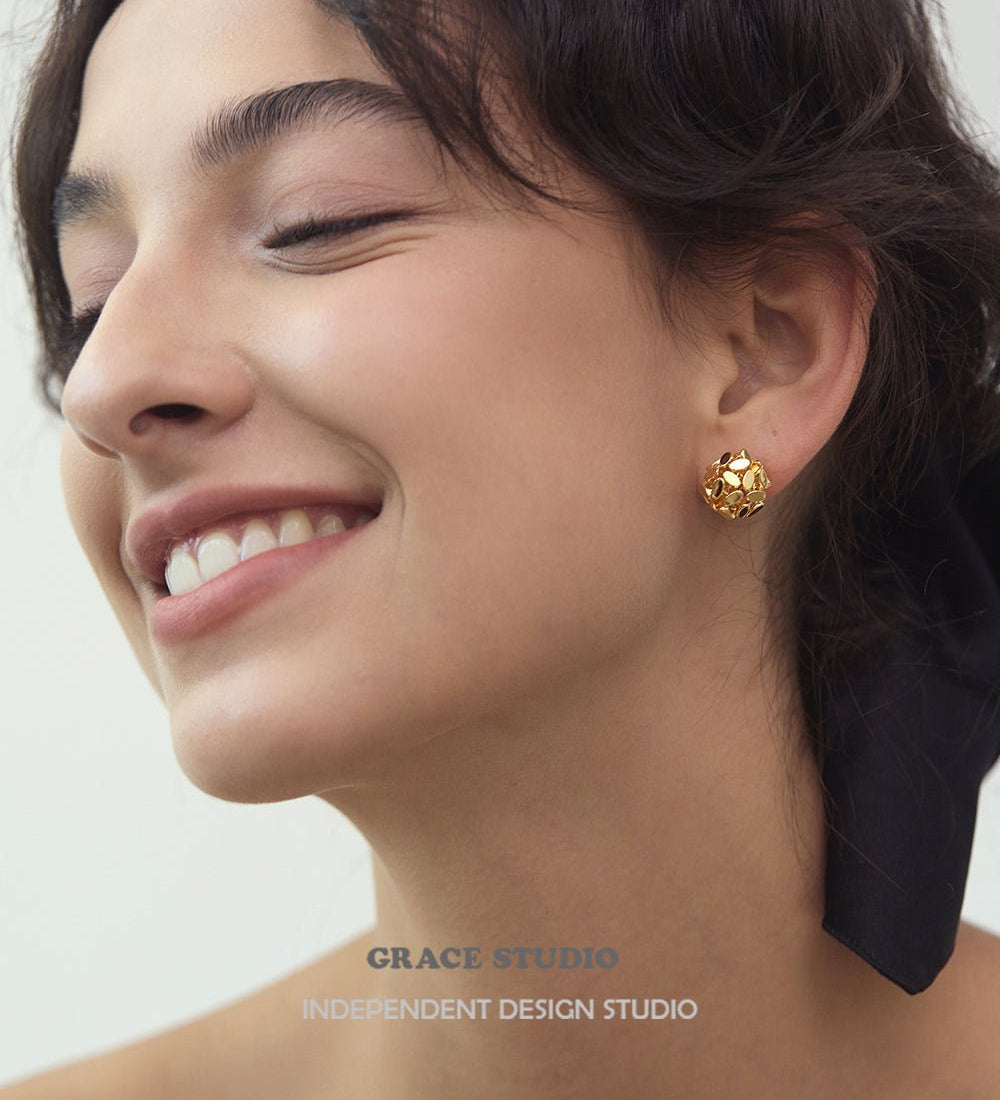
The Glossy Bean Curve Stud Earrings are a good example. They stay close to the ear, but their polished curved surface is still easy to see.
I’d try them first with a black shift, column dress, or sleeveless mini.
If I put them on and the outfit still feels a little bare, I probably wouldn’t change the earrings immediately. I’d add something lower down, perhaps a cuff or smooth bangle at the wrist.
That lets the earrings stay compact while another rounded shape appears elsewhere.
As for gold or silver, I’d wear the finish you already like on yourself. I don’t feel any need to repeat it everywhere.

2. Two-Tone Drops When You Want to Mix Gold and Silver

I like mixed metals most when there’s some visible connection between them.
A two-tone earring makes that pretty effortless because the combination already exists in one piece.
The Silver Teardrop Dual-Tone Jacket Drop Earrings pair a small gold-tone stud with a silver-tone droplet underneath. At approximately 2.5 cm long, they have enough length to register without becoming a very large earring.
With a black halter dress, I’d probably stop there at the neckline and add a gold cuff.
Different dress? Different approach. If yours has a simple scoop or V-neck, you could try a fine silver necklace instead.
I like that you can move between the two metals without making the whole outfit feel carefully matched.
Who What Wear covered mixed-metal jewelry in July 2026, so I wouldn’t worry about treating gold and silver as separate wardrobes.

3. Pearl Drops When You Want Something Softer

When I’m wearing pearls with black, I try to forget the broad category of “pearl jewelry” for a second.
A pearl stud, a clustered drop, and an irregular baroque earring can look completely different on. Different pearl shapes can change the overall effect even when the color stays similar.
The Bubble Cluster Pearl Drop Earrings combine silver-tone beads with a natural freshwater pearl. They’re roughly 2 cm long, so most of the shape stays close to your ear.
If I wanted something neat and compact, this is where I’d probably start.
White pearls also create a fairly clear contrast against black. You notice the difference in color first, then the rounded cluster and pearl underneath.
If you prefer something less crisp, a gray or darker pearl can make the contrast softer. If pearls are the direction you want to explore further, the guide to how to style a pearl necklace gives a broader way to think about proportion and placement.

4. Small Crystal Drops When the Dress Already Has Detail

Black lace is where I often catch myself adding too much.
The same goes for beading, ruching, sheer panels, strong shoulder details, or a heavily worked bodice. The dress is already giving your eye plenty to look at.
So I usually try a smaller earring first.
The Duo Sparkle Cubic Zirconia Drop Earrings use two clear stones in a short vertical arrangement on a gold-tone hook. You still get reflection and a little movement, but the earrings don’t occupy much space. The difference between dangle and drop earrings is useful here because movement can matter as much as length.
I’d try them with black lace or a beaded dress, then move away from the mirror.
That last part matters more than it sounds. Up close, a small earring can seem almost invisible. At normal viewing distance, it may be exactly the right amount.
Vogue’s 2026 black-dress styling guide also includes black lace worn with delicate drop earrings.

Match Jewelry to the Dress Surface
Black gives jewelry strong contrast, so the dress fabric and surface detail matter more than the color alone.
| Dress surface | Good starting point | Watch for |
|---|---|---|
| Plain matte fabric | Sculptural metal, pearl, or pendant | Jewelry that feels too small |
| Satin / sheen | Pearl, brushed metal, clear stones | Every surface competing for shine |
| Lace | Small drop or restrained stud | Settings catching or visual overload |
| Beading / ruching | Compact earrings or ring | Another busy focal point |
| Knit | Long pendant or broad metal shape | Tiny details disappearing |
Then I Look at the Neckline
I don’t assume a black dress needs a necklace.
When I do add one, I care much more about where it physically lands than whether someone would call it the “right” necklace for black.
A short necklace usually needs some exposed skin around the collarbone. A long necklace tends to look better when there’s enough plain fabric underneath it. The guide to choosing the right necklace length is useful when a few centimeters can change where the piece meets the dress.
This is one of those decisions I find almost impossible to make with the jewelry lying on a table. Put it on with the dress.
A necklace you wear constantly with a T-shirt can suddenly hit the wrong place once you add a square neckline, gathered fabric, or a high collar.
5. A Short Pearl and Stone Necklace for an Open Neckline

Scoop, square, strapless, and off-shoulder dresses usually give you a natural place to try a shorter necklace.
The Mixed Gemstone Pearl Bead Choker Necklace combines freshwater pearls with faceted semi-precious stones in brown and golden tones. It measures approximately 38 cm, or 15 inches, with a 5 cm, or 2-inch, extender.
What draws me to this kind of necklace against black is the difference in surface.
You get smooth pearls beside faceted stones. The dress isn’t adding another pattern underneath them, so those small changes are easier to see.
I’d use the extender rather than assuming the shortest setting will automatically look best.
If the necklace keeps settling directly on the edge of your dress, move it. A little higher or a little lower can make a surprising difference. It also helps to understand the main parts of a necklace when you are judging the clasp, extender, chain, and pendant as separate fit decisions.

6. A Long Pearl Station Necklace Over Plain Black Fabric

A long pearl necklace changes the placement completely.
Instead of putting everything around the collarbone, you’re spreading the jewelry down the front of the dress. If you like that longer placement, the guide to how to wear long pearls gives more context on how long pearl strands behave over clothing.
The Elegant Baroque Pearl Station Necklace is approximately 91 cm, or 36 inches, long. Irregular baroque pearls are spaced along the chain, with Gray and White versions available.
I’d probably save it for a fairly simple dress: a black knit column, a clean maxi, maybe a plain long-sleeve dress.
The spacing between the pearls helps here. You still see plenty of the black fabric underneath.
I always check the bottom of a long necklace too.
Where does it actually end?
If your dress has a belt, gathered waist, cutout, or obvious horizontal seam, the lowest part of the necklace may land directly on it. Sometimes that looks perfectly fine. Other times, I end up adjusting the length.

7. A Long Silver Pendant When You Want One Shape

Some days I don’t want beads, layers, or several chains. I want one pendant and a lot of black around it.
This is especially appealing to me with high-neck dresses.
The Sculptural Silver Shell Long Necklace has a ribbed shell pendant on a fine chain and measures approximately 77 cm, or 30 inches.
The ridged surface gives the pendant definition without introducing another color. That kind of shape-led detail is one reason sculptural jewelry works especially well against plain black fabric.
Against a black dress, the silver shape is easy to read. The long chain also gives the pendant enough distance from a high neckline.
I’d try it with a high-neck knit or plain column dress. And before I layered anything else, I’d look at the pendant alone. If you do decide to add another piece, the guide to layering pendant necklaces is useful for keeping the lengths distinct.
Very often, that’s where I stop.

Where to Put the Next Jewelry Detail
Once the ears and neckline feel settled, I move the next point of interest lower instead of adding more near the face.
| What already feels finished | Good starting point | Watch for |
|---|---|---|
| Ears only | Add necklace or cuff | Stacking too many pieces at once |
| Ears + neckline | Add cuff or ring | Crowding the upper body |
| Strong neckline | Skip necklace; use wrist or hand | Forcing jewelry into limited space |
| Long pendant already on | Keep earrings compact | Competing vertical lines |
| Detailed sleeves | Use ring instead of cuff | Bracelet catching or distorting fabric |
If the Neckline Already Feels Finished, I Move Lower
This is probably one of my favorite ways to wear jewelry with a black dress.
If the ears and neckline already look settled, I don’t automatically add more near my face. I’ll move the next detail to my wrist or hand.
You might find this useful with halters, strapless dresses, interesting collars, or a bodice you’d rather leave visible.
8. A Curved Gold Cuff on a Bare Arm

The Wavy Form Open Cuff Bracelet is an adjustable gold-plated brass cuff with an asymmetrical outline.
I’d personally wear it with a sleeveless dress first.
You can see the whole shape against bare skin, and it gives you another visible detail without putting anything on the neckline.
I also like it with two-tone earrings. Gold can appear in both pieces, but the jewelry still doesn’t look like a formal matching set. If you are comparing wrist options, the guide to a bangle, cuff, and chain bracelet is useful because each construction behaves differently on the arm.
You can wear a cuff over a sleeve too. I’d test that at home, though.
If it drags the sleeve down, twists around constantly, or catches the material when you move, I’d put it back on bare skin.

9. A Wide Resin Bangle When You Don’t Want More Metal

Sometimes I want something substantial at the wrist but don’t want another shiny surface.
That’s where I start thinking about resin.
The Sculptural Organic Bangle Bracelet has an asymmetrical solid-resin form with an inner diameter of approximately 6.3 cm.
A lighter version gives you obvious contrast against black.
A black version is quieter. Because the colors are close, I notice the width and outline of the bangle more.
And here’s the practical part I would check before getting attached to either look: make sure you can actually get the bangle over your hand.
A wrist measurement isn’t enough for a closed bangle. I’d compare the inner diameter with one you already wear comfortably.
I also start with one rather than immediately building a stack. That restrained approach is close to how I think about minimalist jewelry when the dress already has a strong silhouette.

10. A Gemstone Ring When You Want One Small Change

A ring is often where I end up when the top half of my outfit already feels finished. If you want to think more deliberately about placement, the guide to what each ring finger can mean gives a useful reference before you decide where to wear it.
It gives you another material or bit of color without changing anything around your face.
The Sculpted Dome Gemstone Statement Ring has a wide gold-tone domed band with a rounded gemstone center.
If I wanted everything to stay fairly close in color, I’d choose the black version.
A lighter stone gives you a clearer break from the dress.
I wouldn’t automatically repeat the stone color anywhere else.
A gemstone ring, black dress, black shoes, and neutral bag can be enough. You don’t have to go looking for matching earrings so the outfit makes sense.
If you normally stack several rings, try the gemstone ring by itself first. I often prefer seeing the full shape before deciding whether another band belongs next to it.

Gold, Silver, Mixed Metal, or Something Else?
I would choose the finish from the whole outfit rather than treating black as a color that demands one metal.
| Outfit direction | Good starting point | Watch for |
|---|---|---|
| Warm accessories | Gold or warm-toned stones | Changing everything just to match |
| Cool accessories | Silver or gray pearls | Ignoring the rest of the hardware |
| Mixed hardware | Two-tone jewelry | Adding extra metal only for symmetry |
| Keep contrast soft | Black resin or dark pearls | Jewelry disappearing completely |
| Want stronger contrast | White pearl, silver, or clear stone | Too many bright accents together |
Three Combinations I’d Try First
If you’re still standing there wondering where to begin, these are three combinations I’d probably test first.
They’re starting points. Your dress may take you somewhere else once you put everything on.
| Your dress | Jewelry to try | How I’d wear it |
|---|---|---|
| Plain black halter or sleeveless dress | Silver Teardrop Dual-Tone Jacket Drop Earrings + Wavy Form Open Cuff Bracelet | I’d leave the neckline bare and keep the jewelry at the ears and wrist. The small amount of gold in both pieces connects them without making them look matched. |
| Plain black high-neck knit dress | Sculptural Silver Shell Long Necklace + Glossy Bean Curve Stud Earrings | I’d let the pendant use the open area across the dress and keep the earrings close to the ear. |
| Black lace or embellished dress | Duo Sparkle Cubic Zirconia Drop Earrings + Sculpted Dome Gemstone Statement Ring | I’d keep the sparkle compact near the face and move the stronger shape down to the hand. |
I’d still put every combination on before deciding.
Jewelry looks different once your hair, skin, neckline, sleeves, shoes, and bag are part of the picture.
I’ve had plenty of outfits where everything looked perfect laid out on the bed. Then I put it all on and immediately removed something.
That happens.
Sometimes the piece you were sure you needed is the first one that feels unnecessary once you see yourself dressed.
A Few Things I Check Before I Leave
I’ve found that many jewelry problems with black dresses are surprisingly ordinary.
Something catches. Something slides. Something taps your collar every time you turn your head.
If a pendant keeps landing directly on your neckline, I’d adjust the length before changing the whole necklace.
If your earrings touch the collar every time you move, pay attention to that too. It may seem minor when you’re getting dressed, but after an hour it can become irritating.
I check bracelets the same way. A cuff worn over a sleeve should sit comfortably without pulling the fabric. With a closed bangle, I want to know I can remove it without a struggle.
One last thing I do fairly often: take a phone photo.
A mirror encourages me to stare at individual details. The photo makes me look at the whole outfit.
Sometimes I notice that the jewelry I loved up close is competing with the part of the dress I liked most.
If you bought the dress because you loved its neckline, lace, shoulders, or bodice, you may decide you’d rather leave that area alone.
FAQs
Is gold or silver better with a black dress?
I don’t think one automatically looks better.
Black gives both metals enough contrast to show clearly, so I’d choose according to the jewelry you like and what you tend to wear.
You can mix them too. A two-tone earring can make that combination feel especially easy, but I wouldn’t say you need one every time you wear gold and silver together.
Do you need a necklace with a black dress?
No. I often try the dress without one first.
If you have a halter neckline, high collar, decorated bodice, or strong shoulder detail, earrings plus a cuff or ring may already feel complete to you. That is also where classic jewelry can be useful as a reference for keeping the styling restrained.
Then add the necklace and compare.
I’d keep whichever version you prefer rather than assuming more jewelry means a more finished outfit.
Can you wear pearls with a black dress?
Yes. I’d think about shape and placement before anything else.
Small clustered pearl drops keep the detail near your face. A long station necklace moves the pearls down across the dress.
They’re both pearls, but they give you very different outfits.
Can you wear statement earrings and a necklace together?
Yes, if you like how they look together.
I wouldn’t remove the necklace automatically because your earrings are large. ELLE’s fall earring coverage includes substantial earrings worn with other jewelry.
I pay more attention to spacing and comfort.
Put both pieces on. Turn your head. Move your shoulders. Look at yourself from a few feet away rather than six inches from the mirror. The same practical test applies to drop earrings because collar and shoulder contact can change whether a longer earring actually feels good to wear.
If the pieces start to feel crowded, take one off and compare again.
If you like them together and they’re comfortable, I wouldn’t let an old styling rule make the decision for you.
Infographic






Leave a comment